


Two years ago, we planted a seed. Not in soil, but in classrooms and forests across Carinthia. That seed was called B.A.U.M., and while the name has shifted over time – today it stands for Bildung, Abenteuer, Umraumgestaltung, Miteinander – the idea remains rooted in the same vision: to learn with and from the forest.
When we started, we thought about furniture, about “Sonderwüchse” (those strange and beautiful wood growths that carpenters sometimes treasure). But as so often happens, the project grew in a different direction. Instead of building tables and chairs, we began to build learning spaces. Forests became classrooms, curiosity the compass, and collaboration the glue.
Bildung – Learning that breathes
Education is not only about textbooks and whiteboards. In B.A.U.M., learning happens while touching bark, sketching the veins of a leaf, or listening to the creak of a tree in the wind. By observing forests, students begin to understand cycles – of nutrients, of materials, of resilience.
Teachers often ask: But how do I bring biomimetics or circular economy into my classroom? B.A.U.M. makes it easy. The project’s website baum.framer.ai hosts ready-to-use materials and short videos. These are free, adaptable, and tested in real schools. They invite students to ask: How does the forest solve problems? and What can we learn for our own designs and systems?
Abenteuer – Adventures in noticing
Children don’t need much to turn a walk into an adventure. In B.A.U.M., the forest is never just background – it becomes the stage. Younger pupils invent clay creatures inspired by roots and twigs; older students take sketchbooks into the woods, turning observation into design ideas.
Adventure here means giving permission to explore, to imagine, to make mistakes. When a group of students builds a creature from moss and clay, they are not only playing – they are rehearsing biomimetic thinking: seeing functions in forms, inventing by observing. For teachers, these adventures are structured enough to guide learning, yet open enough to spark imagination.


Umraumgestaltung – Rethinking our spaces
One of the most exciting aspects of B.A.U.M. is how it shifts perspective: instead of designing new “stuff,” it encourages us to redesign the way we use and value space. A fallen tree is not waste – it is habitat, resource, memory.
This ties directly to the circular economy. Students learn that forests have no trash bins: everything is reused, transformed, cycled back. In workshops, they explore how human systems could do the same. Even simple redesign exercises – reimagining an everyday object with nature’s principles in mind – train a kind of future literacy.
And perhaps this is where biomimetics shows its full power: it doesn’t just inspire new products, but new ways of thinking about the spaces we inhabit and the systems we shape.
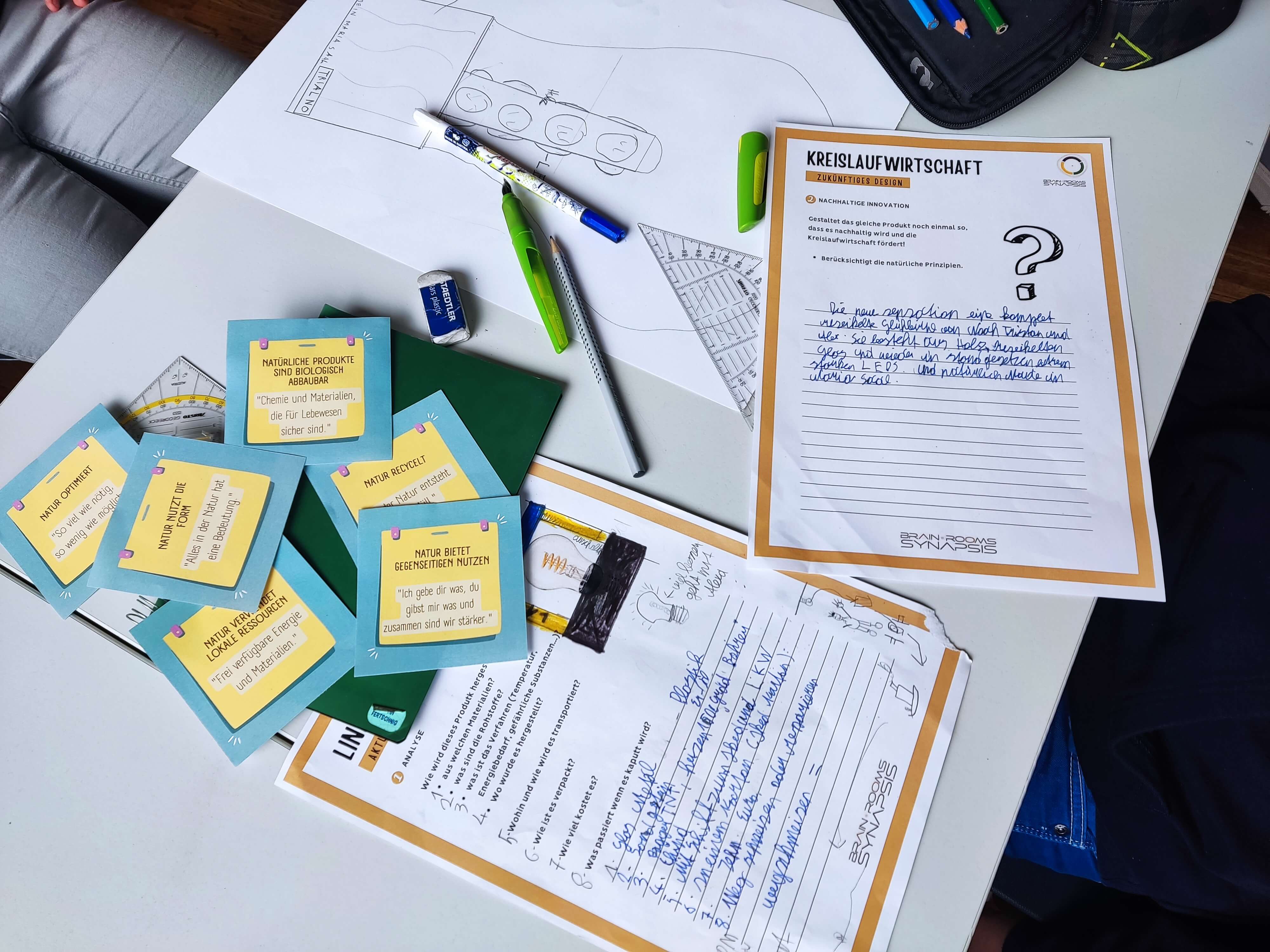
Miteinander – Learning with, not just about
Education is never a solo act. B.A.U.M. thrives on collaboration: between schools and universities, between younger and older students, between disciplines. Secondary students mentor primary pupils, discovering that teaching deepens their own understanding.
This Miteinander extends beyond the classroom walls. Teachers share experiences across schools; scientists and designers bring in perspectives that enrich the lessons. And the forest, too, is part of this togetherness – a silent partner reminding us that ecosystems flourish only through interdependence.

Why it matters now
We live in a time when students urgently need both ecological literacy and creative courage. The climate crisis is no longer abstract; sustainability can’t remain a buzzword. Projects like B.A.U.M. show that schools can nurture both awareness and action – not by adding another heavy chapter to the curriculum, but by connecting what’s already there in fresh ways.
The resources are free. The activities are adaptable. Teachers don’t need to be experts in biomimetics or ecology – they only need to be willing to step with their students into the adventure of noticing, questioning, and reimagining.
Invitation
Two years on, B.A.U.M. is no longer just a project. It is becoming a living curriculum – one that educators can take, adapt, and let grow in their own classrooms.
So here’s the invitation: Visit baum.framer.ai. Download a worksheet. Watch a short video for better understanding. Try one activity outdoors. See how curiosity takes root.
Because in the end, B.A.U.M. is less about teaching the forest and more about teaching like the forest: adaptive, generous, interconnected. And perhaps, if we learn this well, our schools too can become ecosystems where Bildung, Abenteuer, Umraumgestaltung, and Miteinander grow tall together.
Anja
